Amy Saper
Improving Construction Design with AI: Our Investment in Buildcheck

Buildcheck founders
I’ve been spending a lot of time with teams applying AI to technical, operational workflows, where small mistakes carry huge price tags. Construction design review is one of those areas. Anyone who has worked on a large-scale commercial or residential project knows how many parties touch a drawing set, and how easily coordination errors can snowball into costly surprises or dreaded change orders in the field. For example, it’s surprisingly common for the architect’s plans to show an opening or wall in one place, while the structural plans show something else. Propagated across hundreds of units in a large building, this error can cause delays and massive expense to fix.
Construction is a $12 trillion (with a “t”) industry, yet design reviews still happen manually through PDF markups, siloed comments, and endless back-and-forth between architects, engineers, general contractors, and owners. Construction design errors alone create more than $200 billion of waste each year. When a drawing does not accurately reflect what is actually buildable, or doesn’t align with the original design intent, everyone pays in delays, change orders, and lower margins.
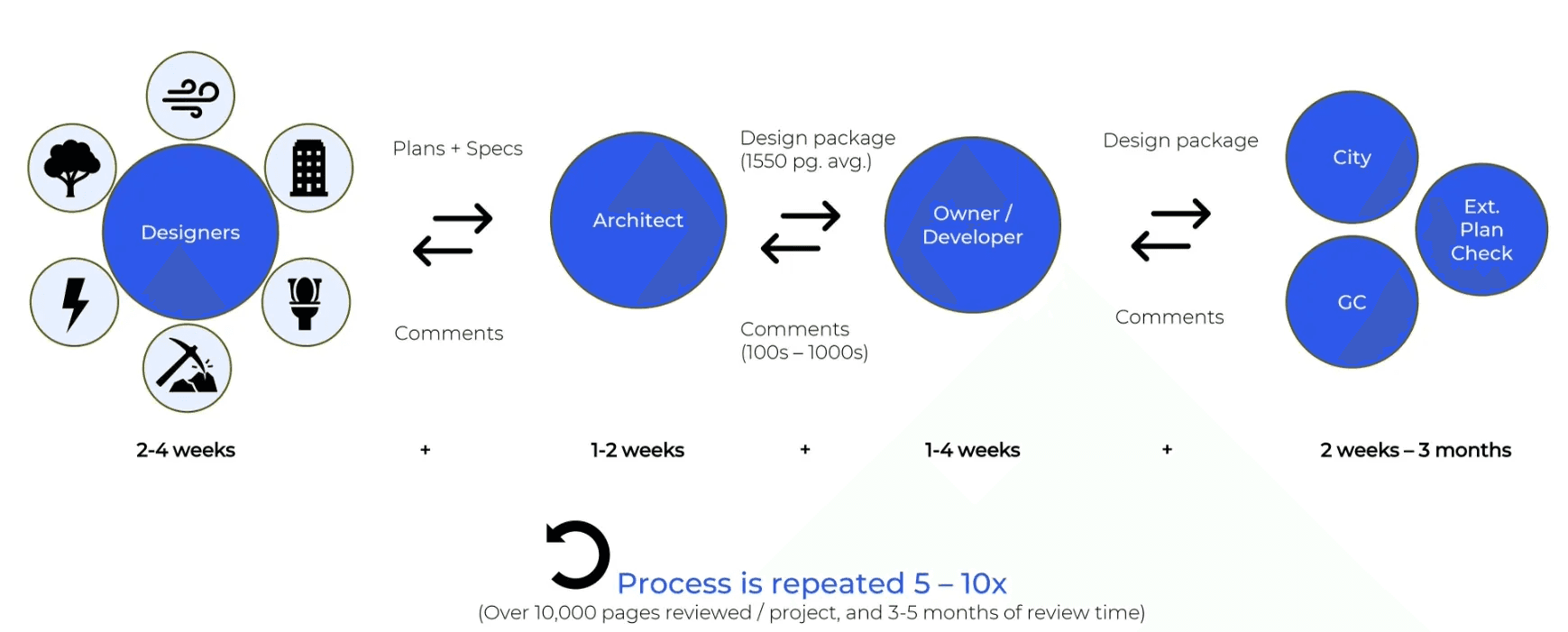
The typical construction design review process
By leveraging AI to solve this problem, Buildcheck has already earned the trust of more than fifty construction organizations, including AvalonBay Communities and Novo Construction. Buildcheck leverages custom-built AI models that enable it to catch issues that more general-purpose tools might miss. Their platform interprets layouts, annotations, and plan relationships at scale, surfacing problems long before they reach the field. For one developer of a 40-story high-rise tower, Buildcheck found a two-foot difference in the thickness of the foundation slab between structural and geotechnical drawings. This was a difference of six million pounds of reinforced concrete, at least $800k in raw materials alone, let alone rework costs and soil issues if discovered during construction.
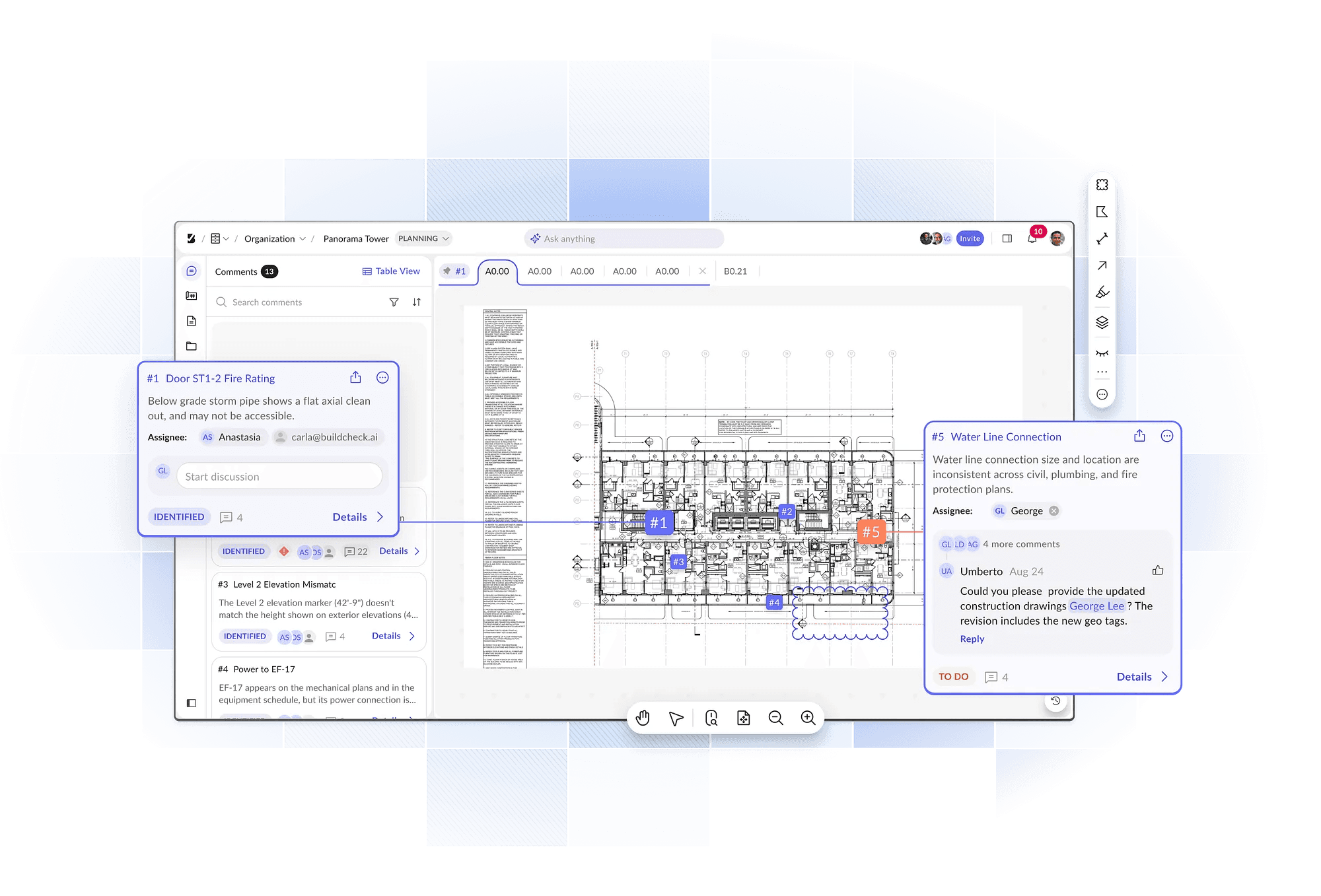
Design review with Buildcheck
I first met the founders several years ago when they were just getting started, and I immediately recognized the strong founder-market fit. Their experience uniquely positions them to tackle this technically and operationally complex field, where industry relationships are everything. Alex Michalatos spent years managing technical scopes on major construction projects, where he saw firsthand how preventable design issues derail schedules and budgets. Andrei Molchynsky brings deep experience navigating complex commercial environments. Alex Gureev is a seasoned engineering leader applying advanced computer vision to the robust but historically underutilized dataset of construction drawings. They met at Stanford and have been executing quickly ever since, signing customers, iterating with real design teams, and proving value across developers, general contractors, and architects.
When we reconnected prior to their seed round, what stood out most to me about Buildcheck was the depth of the customer enthusiasm. It’s rare for a company this early to have references this strong, especially from enterprise-sized customers. Everyone we spoke with could point to specific issues that Buildcheck caught. AvalonBay summed it up well:
‘Every missed issue in a drawing becomes a surprise expense on-site…Buildcheck helps us reduce risk and make better use of our time and capital.’
In an industry that’s often slow to embrace new technology, I was genuinely impressed by their ability to quickly close well-known large customers.
Buildcheck’s models are improving rapidly, and they’re aiming to automate major portions of the pre-construction process, like code checks, coordination, constructability assessments, and risk analysis. Pre-construction is full of repeated patterns and high-stakes decisions, which makes it a place where AI can deliver clear, tangible value.
We are thrilled to lead Buildcheck’s seed round, partnering with Alex M., Alex G, Andrei, and the early team members as they build the intelligence layer that helps construction teams operate with clarity instead of uncertainty. Construction deserves modern, AI native tools, and Buildcheck shows what’s possible when deep domain expertise meets custom models designed for the realities of how things actually get built.