Sarah Du
Mapping Out Mental Health Tech: 70+ Startups Changing Lives
As we continue to fight COVID-19, the nation’s mental health crisis continues to intensify.
In a recent study by the U.S. Centers for Disease Control and Prevention, 1/3 of Americans reported symptoms of anxiety and depression, compared to 1/9 in Q1 of last year. SAMSHA, the National Helpline for mental health crises, has seen an 891% increase in call volume from this time last year. Employers are taking note and showing greater interest in finding solutions for their employees. As shown below, the number of earnings calls mentioning the term “mental health” skyrocketed in Q2 of this year.
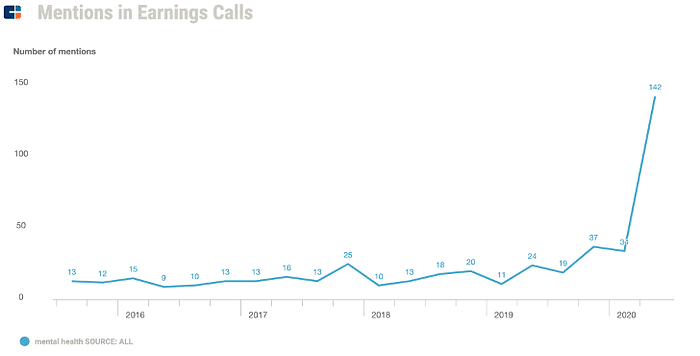
Number of mentions of “mental health” in earnings calls (Source: Crunchbase)
Even before COVID-19, the world was already in a mental health crisis.
According to the World Health Organization, 1 in 4 people in the world will experience mental or neurological disorders at some point in their lives.[1]
In the U.S., 90% of suicides are related to mental illness, and more than 47,000 people take their own lives each year.
Numbers, of course, only tell part of the story. They help illustrate the scale and severity of our nation’s mental health crisis, but even more importantly, each of these numbers represents a valuable human life. In the last few years, I have thought deeply about mental health and have seen close friends struggle with depression and anxiety.
Mental health is an issue I care deeply about, and I am hopeful that mental health technologies can positively impact the many around the world.
Below, I outline 1) key challenges and opportunities in mental healthcare in the U.S., 2) the current market map of startups tackling mental health globally, and 3) investable trends.
Key Takeaways:
1. Mental health is a critical issue, affecting 450 million people worldwide and 1 in 4 adults in the U.S.
2. Four of the biggest challenges in mental healthcare are lack of access, inconsistent quality, regulation at times constraining innovation, and discrimination.
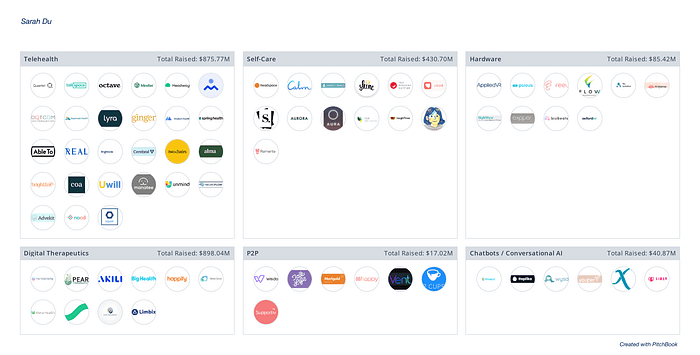
3. There are many ways to segment the market. I’ve mapped six categories: self-care, chatbots, P2P, telehealth, digital therapeutics, and hardware.
4. Six areas I predict continued momentum are: 1) solutions for mild and moderate cases of mental illness, 2) solutions focused on prevention and upstream intervention through seamless monitoring and diagnoses, 3) the unbundling of mental health services, 4) solutions targeting youth, 5) senior-focused solutions, and 6) provider tools that monitor and improve patient outcomes.
Want to read this story later? Save it in Journal.